_edited.jpg)
Self Leadership Series : From ‘Doing’ to ‘Being’ : Different styles, different circuits
The Doing Leader’s biggest challenge. When to flip your style and how ?

For fifteen years, Alex was the person you wanted on the hardest problem in the room. Give him a failing payment system at two in the morning and he would have it traced, patched and documented before the first coffee. His promotions came the way they come to brilliant builders — because he delivered, again and again, better than anyone around him. So when the his company made him VP of Engineering, everyone agreed it was overdue.
Six months in, Alex was quietly miserable, and worse, confused. He was working harder than he ever had. He was reviewing every critical pull request, jumping into every incident, rewriting the messy architecture decisions his teams brought him. And yet his function was slower than before. Good engineers were leaving. In his skip-levels people described him, kindly, as “hard to read.”
Alex was the one who was always in-charge, in the room. He had assumed a higher position was the same job at a larger scale — more problems, solved by the same brain that had always solved them. What nobody had told him is that the attention system that was always used to spotting the task undone, was not being used to catching the signals on people’s faces when they felt unattended or unheard. It had worked for some years but it was not working any more.“Do you have a design in mind for your blog? Whether you prefer a trendy postcard look or you’re going for a more editorial style blog - there’s a stunning layout for everyone.”
What the brain is actually doing
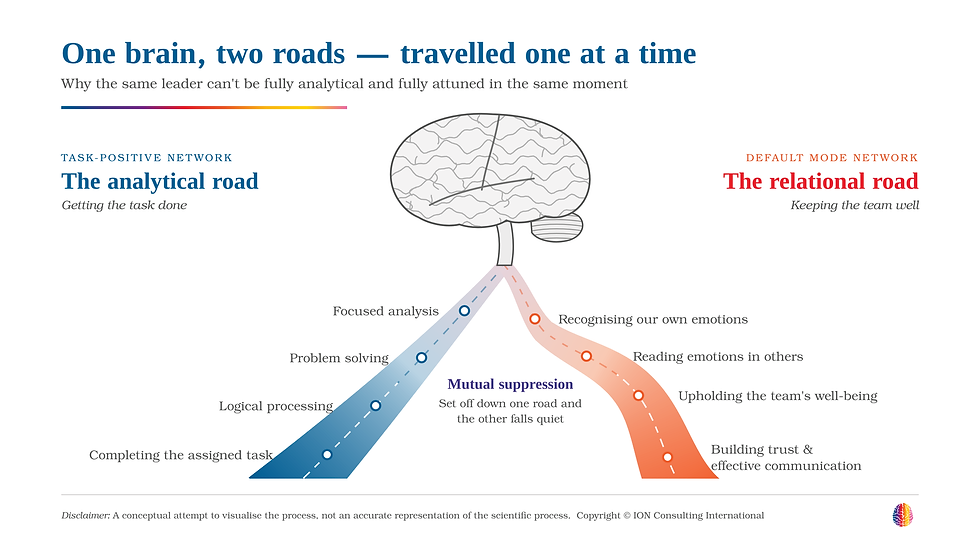
The brain runs two large-scale networks that pull in opposite directions. One is the task-positive network (TPN) — the circuitry for focused analysis; problem solving, logical processing and in other words getting assigned task completed. The other is the default mode network (DMN) which plays a critical role in recognising personal emotions and emotions in the people around us — focused on upholding the team’s well-being and place value on building trust and effective communication. Usually, when one network is active, it suppresses the other (Boyatzis, Rochford, & Jack, 2014).
Fifteen years in a task-oriented role trains one of these networks like an athlete trains a dominant side. Repeated activity strengthens and makes more efficient the neural pathways we use most, while pathways we stop using weaken over time — the ordinary machinery of habit and neuroplasticity (Draganski et al., 2004). Alex’s analytic circuitry became his fastest, most trusted default. His attuning-to-people circuitry simply got less practice and the neural pathways towards emotional connection may be weakened (Pascual-Leone et al., 2005). In a non-conscious mode, Alex was not used to picking up facial signals. He was not getting better at reading the room.
Rather than fading from lack of use, the DMN may become less familiar for Alex to intentionally engage and apply in practical, everyday contexts. Activating it starts to feel exhausting and unnatural, which caused him to avoid it even more — trapping him in a self-reinforcing feedback loop that keeps those vital pathways weak (Einarsson et al., 2017). In such situations, task positive leaders, tend to rely on positional authority to close the relationship gap. They simply have no energy for it !
The leadership literature has described two distinct roles — the task-oriented leader and the relationship-oriented leader — since the 1950s, and we now know that this division tracks a real feature of neurobiology, not just a difference in leadership style (Boyatzis, Rochford, & Jack, 2014). An over-emphasis on task-oriented leading can actively cost an organisation when openness to people, emotions and new ideas is what the moment requires. This happens when a functionally brilliant leader makes it to that top notch position and finds himself/herself at sea. Here he is needed to spend more time gauging the dynamics and he has not equipped himself thus far.
Being a great leader isn’t about picking one style — it’s about mastering the toggle. It’s knowing when to flip on the Task-Positive Network (TPN) for sharp execution and when to let the Default Mode Network (DMN) take over for big-picture empathy (Boyatzis, Rochford, & Jack, 2014). For Alex, making that shift isn’t about panic-driven self-criticism. You can’t shame yourself into better leadership. Instead, it was about holding a vivid mental picture of the leader you want to become — and letting that clear vision do the heavy lifting of rewiring your brain. When you look inwards at your default habits, you unlock the power of smooth and intentional change, rather than abrupt shifts (Boyatzis, 2006). But here is the catch: real transformation takes time. Yet, recognising the need for change does not necessarily mean knowing how to initiate it. Alex may still struggle to identify where to begin, making the guidance of a mentor particularly valuable. Mentoring relationships can support the development of intentional self-regulation, helping individuals become more deliberate in how they direct their thoughts and attention (Bowers et al., 2016).
In the world of business, have lazer like focus on operations and switching mode to complete empathy is not a behaviour training that is considered. A lot has to do with the way corporate culture has changed over the years.
Says Prof Richard Boyatzis, “In the ’70s, business became focused on the return-on-investment and cash-flow, and this led to the elevation of financial wizards to demigod status in the ’90s and resulted in the financial meltdown in 2007.” Richard Boyatzis is the professor of organizational behavior at Case Western Reserve’s Weatherhead School of Management and a study author. However, there is a social cost and that shows up in any organization which cannot orchestrate the flip. Burnouts, suppressed dissent, disengagement and eventual dysfunction.
The brain is an amazing organ which is highly flexible and adaptive. It is unlikely that experienced leaders ( not necessarily the performative ones ) do not understand the importance of flipping their styles. The problem arises when there is no acknowledgment of this need. When the leader cannot comprehend how being task-focussed suddenly became a burden instead of a valuable trait.
Every brain is social and every brain needs to feel belonging, validation and appreciation in order to thrive (No wonder that even after ten years of social media, vanity metrics still motivate millions.)
An ION Mirror Check
Not a test, and not a diagnosis — a set of questions to sit with. We all should know our dominant side, as well as when to flex.
Be aware of your dominant side. Task focussed people have to check-in with themselves. Where does my instinct still send me straight to solving the problem myself, when the moment is actually asking me to understand a person?
— A check-in question. When someone brings me something imperfect, does my mind reach first for the flaw in the work, or for the state of the person in front of me?
— This one is tough to answer. What is my picture of the leader I am becoming? Is it vivid enough to pull me, or am I mostly being pushed by the fear of dropping the ball? We have to flex both task orientedness and relationship. It is common that relationship orientedness takes a back seat in the hustle bustle of work management. And for those who are more relationship oriented, they usually struggle to find their place.
At ION, this is where our work begins: helping leaders measure where their attention actually goes, then build the trust, shared understanding, supportive structures and culture that lets a team thrive.
Resources
Boyatzis, R. E., Rochford, K., & Jack, A. I. (2014). Antagonistic neural networks underlying differentiated leadership roles. Frontiers in Human Neuroscience, 8, Article 114 ; https://psycnet.apa.org/record/2014-11383-001
Case Western Reserve University. (2014, March 24). Leaders wired to be task-focused or team-builders, but can be both. ScienceDaily. Retrieved October 5, 2026 from www.sciencedaily.com/releases/2014/03/140324104522.htmhttps://www.sciencedaily.com/releases/2014/03/140324104522.htm
This blog post has been put together by Team ION Consulting.
ION Consulting is a leadership advisory, coaching and training entity. We conduct talks, workshops, conversations, leadership coaching sessions for executives at different stages and levels. We cater to industry practitioners who are interested in the intersection of brain and behaviour. Our work is relevant when the client wants evidence-based strategies to change or impact behaviour. ION is based out of Singapore.
For enquiries, contact nandini.das@ion-consulting.org
Comments